LangGraph
LangGraph vs CrewAI vs AutoGen: Which Should You Use for Multi-Agent Systems in 2026?
MA
Mehwar AI Team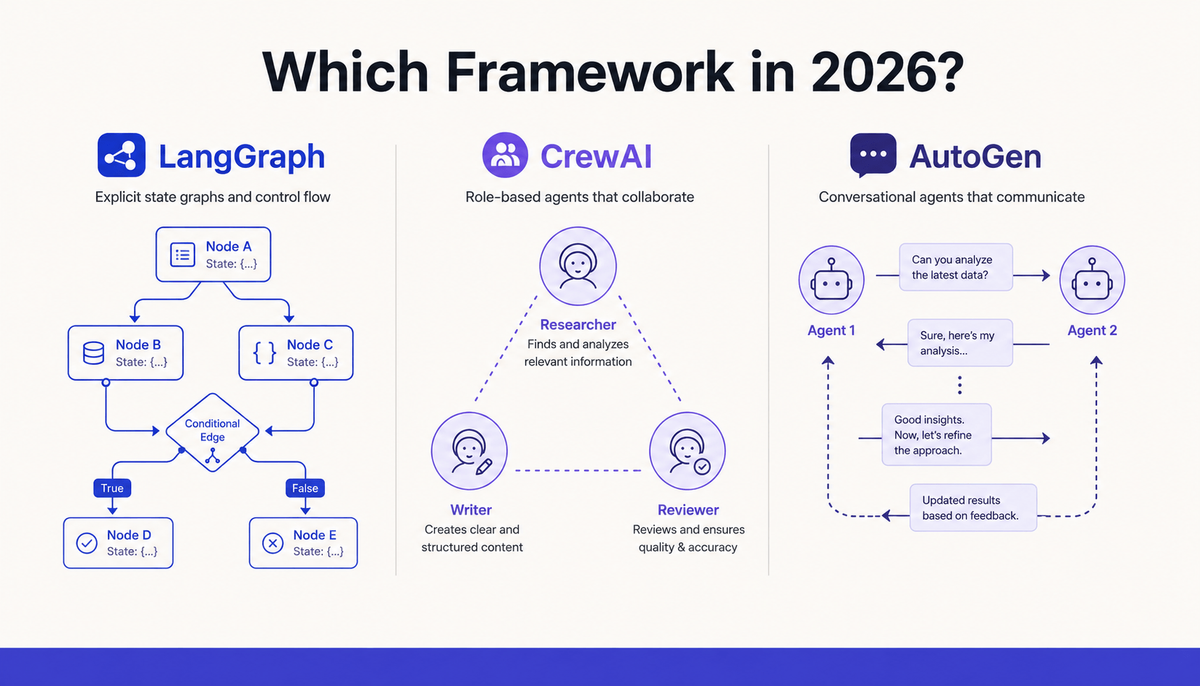
If you are building a multi-agent AI system in 2026, you will eventually face the same question every AI engineer faces: should I use LangGraph, CrewAI, or AutoGen?
All three frameworks can build multi-agent systems. All three are actively maintained and have strong communities. But they make fundamentally different architectural choices that lead to very different production experiences.
At Mehwar AI, we have built production systems with all three. Here is our honest comparison.
The Core Architectural Difference
LangGraph models your agent system as a directed graph. You define nodes — each node is a function that does work — and edges that connect them. Edges can be conditional, meaning the agent decides at runtime which node to visit next based on its current state. Everything flows through a shared state object that every node can read from and write to.
CrewAI models your agent system as a team of workers with defined roles. You create agents with specific jobs — a Researcher, a Writer, a Reviewer — and assign them tasks. CrewAI handles the coordination automatically, deciding which agent works on what and in what order.
AutoGen models your agent system as a conversation between agents. Agents are conversational participants that send messages to each other. The conversation continues until the task is complete or a termination condition is met.
LangGraph: Maximum Control, Maximum Reliability
LangGraph gives you the most explicit control over agent behavior. You draw the graph. You define every state transition. You know exactly what path the agent will take through your system.
This explicitness is its biggest strength in production. When something goes wrong — and in production, things always go wrong — you can trace exactly what happened. Which node ran, what state it received, what state it returned, which edge was taken. LangGraph plus LangSmith tracing gives you complete observability over every agent execution.
The downside is verbosity. A LangGraph agent requires more code than the equivalent CrewAI or AutoGen agent. You are writing the graph explicitly rather than letting the framework infer structure.
Best for: Complex multi-step workflows where reliability matters. Incident investigation, document processing pipelines, security log analysis, anything where you need to know exactly what your agent is doing at every step.
CrewAI: Fastest to Build, Best Developer Experience
CrewAI has the best developer experience of the three. Defining a crew of agents with roles and tasks feels natural and requires minimal boilerplate. You can have a working multi-agent prototype in under an hour.
The role-based abstraction maps well to how humans think about teams. A research agent, a writing agent, a review agent — this mental model is easy to communicate to non-technical stakeholders and easy to reason about when designing the system.
The limitation appears in complex conditional workflows. When your agent needs to branch based on intermediate results, retry failed subtasks, or implement sophisticated error recovery, CrewAI's abstractions start to feel constraining. You end up fighting the framework rather than working with it.
Best for: Rapid prototyping, content generation pipelines, research and synthesis tasks, any workflow that maps naturally to a team of specialists working in sequence.
AutoGen: Most Flexible, Steepest Learning Curve
AutoGen is the most academically rigorous of the three frameworks, developed by Microsoft Research. Its conversation-based model is theoretically elegant — agents as autonomous conversational participants — and it handles complex emergent behaviors that the other frameworks struggle with.
The conversation model also makes AutoGen the most unpredictable in production. Because agent behavior emerges from the conversation dynamics rather than explicit state machines or role definitions, it can be harder to guarantee specific behaviors consistently across runs.
AutoGen shines in research and exploration contexts where you want agents to exhibit genuinely autonomous behavior. It is less suited to production workflows where you need guaranteed execution paths and deterministic outcomes.
Best for: Research tasks, open-ended exploration, complex reasoning tasks where you want genuine agent autonomy rather than guided execution.
Production Readiness Comparison
For production deployments, LangGraph wins clearly. The explicit state machine makes debugging straightforward, the LangSmith integration provides production-grade observability, and the deterministic execution paths give you the reliability guarantees that enterprise clients require.
CrewAI is production-ready for simpler workflows but struggles with complex conditional logic and error recovery at scale.
AutoGen requires the most engineering investment to make production-ready, but offers capabilities the other two cannot match for certain use cases.
Our Recommendation
At Mehwar AI, we default to LangGraph for all client deployments. The upfront investment in defining the graph explicitly pays back immediately when the system goes to production — fewer surprises, easier debugging, and systems that clients can trust to run autonomously around the clock.
We use CrewAI for rapid prototyping and internal tooling where development speed matters more than production robustness.
We use AutoGen for research projects and experimental agents where we are exploring what is possible rather than delivering guaranteed outcomes.
The honest answer is that the right choice depends on your specific use case. If you are not sure which framework fits your project, book a free consultation at mehwarai.com/contact and we will help you make the right architectural decision from the start.
Need a build partner?
Let's build something worth documenting.
If you need a production system that improves response times, cuts manual work, or gives your team better access to knowledge, we can help.